
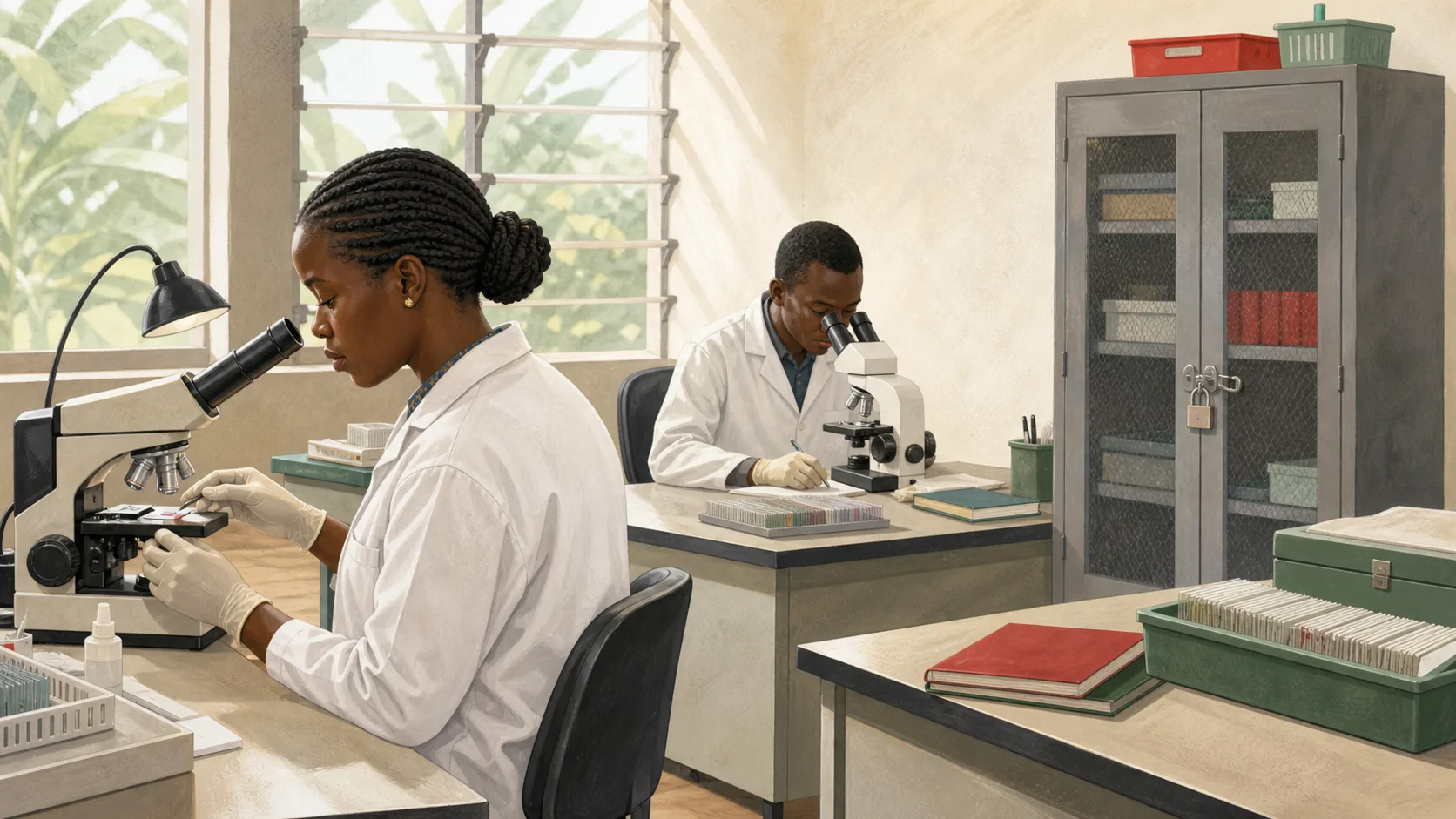
The World Health Organization recommends parasite-based diagnosis by microscopy or a malaria rapid diagnostic test for suspected malaria before treatment. Both methods depend on a quality system that begins long before a result is read.
Public information only: this article explains laboratory-quality concepts. It does not diagnose malaria, replace a qualified health professional or claim an operational Tanale testing service.
What microscopy contributes
Light microscopy can support parasite detection, species work and parasite-density assessment when slides are prepared and examined by competent professionals. Its strength also creates responsibility: stains, microscopes, slide preparation, reading technique, maintenance and second-reading systems all affect quality.
What rapid diagnostic tests contribute
Malaria RDTs can support parasite-based testing where good-quality microscopy is not readily available. They are relatively simple to use, but “simple” does not mean uncontrolled. Product selection, storage temperature, transport, lot and expiry records, user training, timing and interpretation all matter.
Quality assurance is larger than one test
- Before use: define the approved method, select appropriate products, verify storage and train users.
- During use: identify the specimen correctly, follow the authorised procedure, control timing and document the work.
- Before release: apply supervisory review, second reading or other checks appropriate to the method and setting.
- After release: preserve traceability, investigate errors, record corrective action and maintain referral routes.
Why second reading and external assessment matter
Microscopy quality improves when readers receive structured feedback and competency is periodically assessed. A second reading or slide-validation system can identify disagreement, training needs and systematic error. External quality assessment adds evidence that local performance is being checked beyond the immediate bench.
Responsible research questions
With qualified academic, laboratory and public-health partners, Tanale could examine practical questions such as training needs, storage conditions, correct RDT use, second-reading systems and how communities understand prompt testing and referral. Any work involving people, specimens or identifiable health information would require an approved protocol, valid consent and secure data governance.
Technical references
WHO Global Malaria Programme: Microscopy
WHO: The need for quality assurance of malaria RDTs
WHO: Methods manual for laboratory quality control testing of malaria RDTs